Choose fiberglass rope when the verified temperature range of the complete rope assembly is sufficient and the application benefits from good handling strength, dimensional stability, and a practical seal for ovens, boilers, stove doors, access panels, grooves, or general industrial equipment.
Choose ceramic fiber rope when the operating temperature exceeds the validated limit of a fiberglass construction or when a higher-temperature packing and insulation material is required for furnaces, kilns, heat-treatment equipment, expansion joints, and other severe thermal locations.
Do not select by fiber name alone. The finished product may include glass filament, alloy wire, silicone coating, adhesive, or an external metal mesh. The lowest-rated component and the actual service conditions can determine the safe working limit.
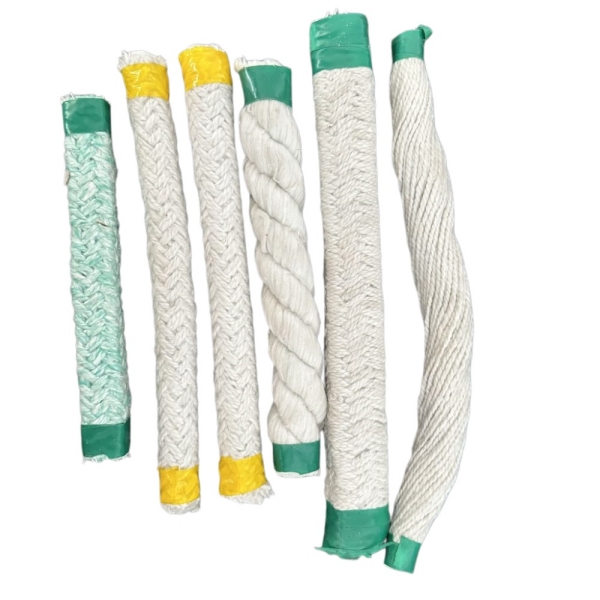
Fiberglass rope is commonly produced from texturized glass fiber yarn and supplied in round, square, braided, knitted, or twisted constructions. It is used where a flexible, non-combustible thermal seal is needed and the complete rope construction is suitable for the specified operating temperature.
For many industrial buyers, fiberglass rope is the first material to evaluate for routine high temperature door sealing, groove packing, thermal insulation, and gasket cores. It generally offers good handling characteristics and can be manufactured in multiple profiles and densities. A coating or jacket may be added when the application needs better surface sealing, reduced fraying, or additional mechanical protection.
Available product options include fiberglass round braided rope, fiberglass square braided rope, and silicone rubber coated fiberglass rope.
Ceramic fiber rope is manufactured from high temperature ceramic fiber yarn and can be reinforced to improve handling strength and structural stability. It is available in round, square, rectangular, braided, or lagging constructions for sealing, packing, gap filling, and insulation.
Its main selection advantage is higher temperature potential than standard fiberglass rope. However, a ceramic fiber classification temperature is not automatically the continuous working temperature of the finished rope. Yarn reinforcement, metal wire, coatings, exposure time, chemical atmosphere, movement, and installation stress must all be reviewed.
For common profiles, compare ceramic fiber round braided rope, ceramic fibre square packing rope, ceramic fibre rectangular packing rope, and ceramic fibre lagging rope.
| Selection Factor | Fiberglass Rope | Ceramic Fiber Rope |
|---|---|---|
| Temperature role | Often selected for moderate high-temperature sealing when its documented continuous rating meets the application. | Considered when higher temperature capability is required and a validated reinforced construction is available. |
| Handling and strength | Typically offers practical handling strength and dimensional stability for routine fabrication and installation. | May require fiberglass filament or alloy-wire reinforcement; the reinforcement must match the temperature and service environment. |
| Available profiles | Round, square, knitted, twisted, braided, coated, or custom fabricated forms. | Round, square, rectangular, braided, twisted, lagging, wire reinforced, or mesh-covered forms. |
| Typical sealing duty | Oven, stove, boiler, access-door, groove, panel, and general thermal equipment seals. | Furnace, kiln, heat-treatment, expansion-joint, high-temperature gap, and severe thermal equipment seals. |
| Surface modifications | Silicone or other treatments may improve surface sealing, handling, or resistance to fraying, subject to compatibility. | Alloy-wire reinforcement or an external stainless steel mesh can improve structural support and surface protection. |
| Buyer priority | Confirm the complete rope's continuous and peak limits, profile, density, and media compatibility. | Confirm the finished construction's continuous limit, reinforcement type, atmosphere compatibility, shrinkage, and mechanical duty. |
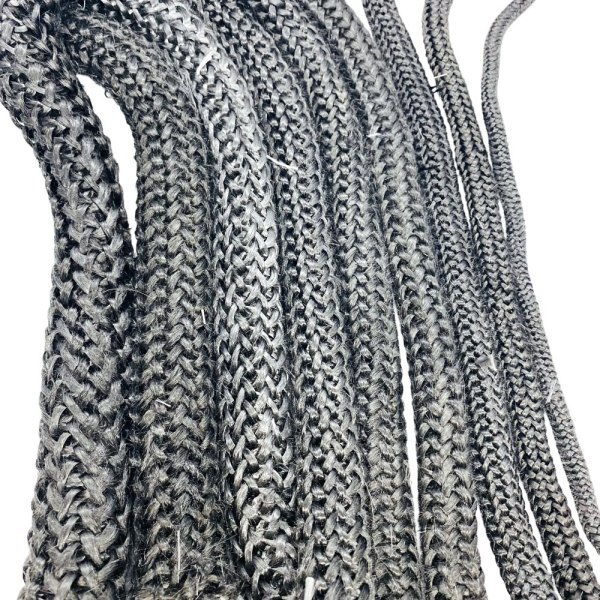
Round rope is a common choice for circular or radiused grooves, door channels, and joints that need a flexible gasket. It can follow corners and irregular paths, but the diameter must match the groove and required installed compression.
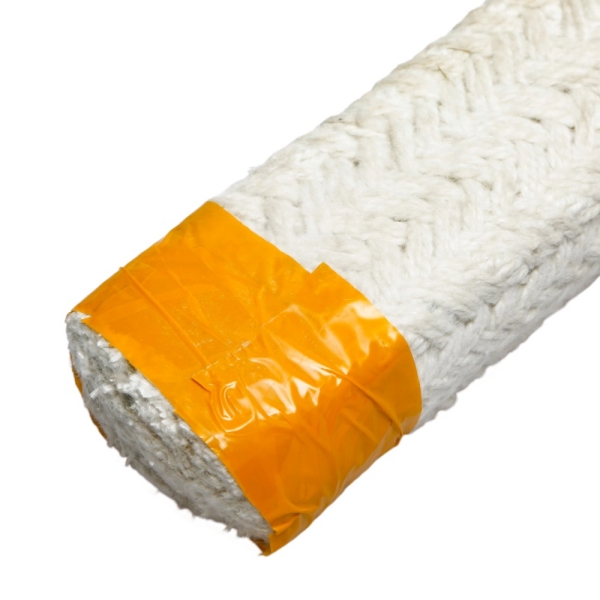
Square rope provides broad contact faces and can sit more predictably in a square channel. It is often evaluated for flat sealing paths, furnace and oven doors, covers, and packing cavities.
Rectangular rope suits wide, shallow channels and sealing paths where width and thickness must be controlled separately. It can reduce the need to force a round rope into a non-round groove.
Lagging rope is generally selected for flexible insulation, pipe wrapping, gap filling, and thermal packing rather than a tightly controlled door-gasket profile. The required density and construction should be stated in the RFQ.
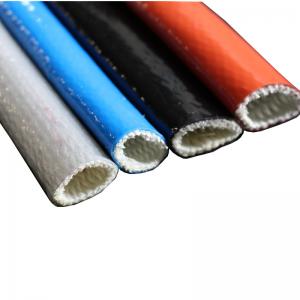
A silicone-coated fiberglass rope can be considered when an uncoated fibrous surface is not ideal. The coating may help reduce fraying, improve handling, and create a smoother sealing surface. Depending on the validated formulation and assembly, it may also support improved resistance to air, gas, steam, liquid splash, or contamination.
The coating does not automatically make the rope suitable for every fluid, pressure, or temperature. Confirm the continuous temperature of the coated assembly, the media compatibility, the joint pressure, and whether the seal is static or exposed to repeated movement. For these duties, review the silicone rubber coated fiberglass rope construction with the supplier.
High heat alone is not the only cause of rope failure. Repeated handling, sharp housing edges, abrasion, vibration, and installation damage can cause a soft rope to fray or lose its shape. In these locations, an external stainless steel wire mesh can protect the rope surface and help the assembly stay intact.
This is different from a rope that only has internal wire reinforcement. Internal reinforcement supports the yarn structure, while an external mesh surrounds the rope body and provides a sacrificial protective layer. For kiln cars, industrial furnace doors, boiler access doors, and similar static seals, consider ceramic fiber rope with an outer stainless steel wire mesh.
A complete request helps the manufacturer recommend the correct material and avoids comparing quotations for different constructions. Include:
No. Ceramic fiber rope offers higher temperature potential, but fiberglass rope may provide a more practical and cost-effective construction when its verified rating meets the application. The best material is the one that satisfies temperature, mechanical, media, profile, and installation requirements together.
It can be used when the temperature at the sealing location, hot-gas exposure, opening cycle, and mechanical conditions remain within the documented limits of the complete rope. Higher thermal duty may require ceramic fiber or another construction.
Round rope is commonly used in radiused channels, while square or rectangular rope can provide broader contact in flat-sided grooves. The groove drawing, sealing gap, and required installed condition should determine the final profile.
Not automatically. Reinforcement can improve handling strength and structural integrity, but the allowable temperature depends on the reinforcement material and every other component in the finished rope. Ask for the continuous rating of the exact construction.
Internal wire is incorporated into the yarn or rope structure to provide support. An outer wire mesh surrounds the rope body and helps protect the surface from fraying, abrasion, and installation damage.
It may be considered for certain steam, gas, or liquid sealing duties, but suitability depends on temperature, pressure, media chemistry, coating formulation, and joint design. These conditions must be supplied for technical review.
Provide continuous and peak temperature, media, pressure, equipment type, groove dimensions, rope profile and size, movement, reinforcement or coating needs, cut or spool length, quantity, packaging, and any available drawing or photo.
Send your application temperature, groove dimensions, equipment details, media, movement, preferred profile, and order quantity. Our team can review the duty and recommend a fiberglass, ceramic fiber, coated, reinforced, or mesh-covered rope construction for OEM, maintenance, distribution, and bulk supply projects.
Compare High Temperature Rope Products
 English
 français
 Deutsch
 русский
 italiano
 español
 português
 Nederlands
 العربية
 日本語
 한국의
 Polski
 Tiếng Việt
 slovenský
 Indonesia